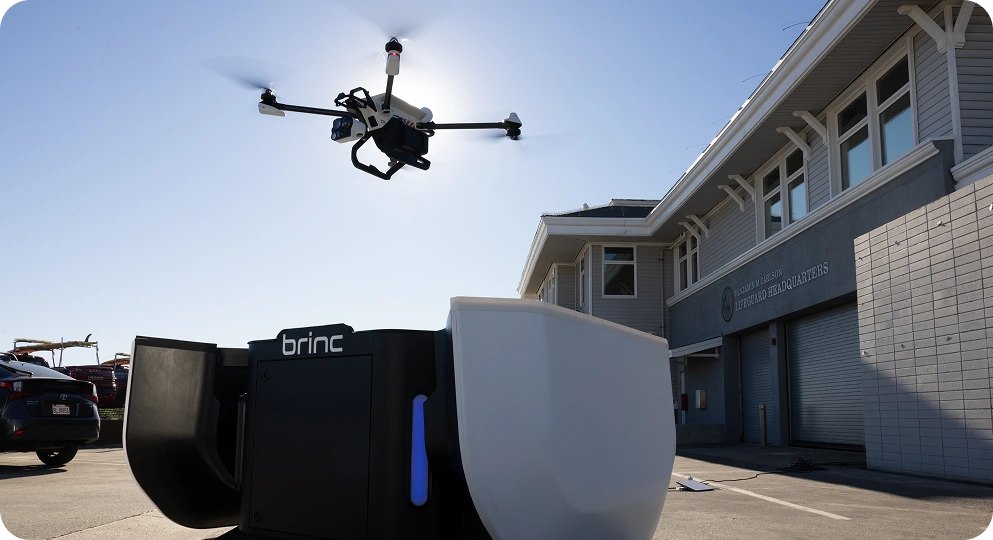
A drone that reaches an emergency quickly can still be unavailable for the next one. That gap is the most consequential part of BRINC’s Guardian announcement. Launched on March 24, 2026, the aircraft is paired with a station designed to replace its battery and load an emergency-specific payload automatically. The promise is not merely a longer flight. It is a shorter, less labor-intensive path from completing one mission to accepting another. BRINC Guardian launch, March 24, 2026
That changes the question a security or public-safety buyer should ask. How often is an aircraft genuinely ready when a useful mission arrives? A launch video cannot answer it. A month of dispatch records can. Our interpretation is that autonomy between emergencies may matter as much as autonomy in the air—and could determine whether drone response becomes dependable infrastructure rather than an occasional specialist service.
The constraint is a sequence, not a distance
Traditional drone response depends on a chain of preparations: an available aircraft, a charged battery, the right equipment, permission to fly, connectivity and someone authorized to make the decision. Flying faster improves only part of that chain. If the aircraft has just landed, its advertised range provides no immediate help. If a useful medical payload is elsewhere, the launch may deliver a camera instead of the equipment the incident needs.
BRINC advertises 62 minutes of flight time and an eight-mile response reach for Guardian. Those are manufacturer specifications, not observed performance across every weather condition and payload. The distinction matters because a response envelope must include travel home and operational reserves. A map of maximum reach is not a map of guaranteed service. The relevant planning unit is an eligible incident served under the conditions that actually occur. Guardian specifications
The station becomes part of the aircraft’s value
Battery replacement and payload loading move work from a person to a mechanism. In principle, that can remove a recurring reason to visit the launch site. But it also creates a different maintenance obligation: the station needs usable batteries, correctly stocked payloads and reliable handling equipment. The work has been reorganized, not abolished. A station that completes repeated exchanges can be more valuable than a marginal improvement in cruise speed.
Consider an illustrative sequence: a drone returns from checking a fire alarm and is then requested for a medical incident. With manual preparation, the second mission depends on someone restoring the aircraft and attaching the right equipment. With the advertised automated system, those steps can occur at the station. The comparison is not a claim that Guardian has demonstrated a particular turnaround time. It identifies the interval that an agency would need to measure before treating the capability as dependable.
The station also changes how spare capacity should be understood. An extra battery can address charging delay; it cannot replace a damaged aircraft. Another aircraft can cover maintenance; it may not overcome a shared station fault. Redundancy at one layer does not remove dependencies at the others. A credible service design therefore describes recovery from a failed exchange or unavailable launch point, not simply its normal cycle.
Dispatch integration can matter more than the airframe
Motorola Solutions’ October 2025 announcement connected this operating model to an established interface: an officer’s APX NEXT radio. The company described a distress signal prompting a request for drone support, with BRINC and SkySafe integrations feeding its command-center environment. That places the aircraft inside an existing response process rather than requiring every potential user to learn a separate drone application. Motorola radio-dispatch integration, October 15, 2025
This is the second important consequence of the readiness thesis. If drones become a frequently requested resource, the system through which requests are prioritized gains influence. A dispatcher must decide whether an aircraft should observe an incident, carry a payload or remain available for a higher-priority call. Those decisions can shape value more than the simple ability to initiate flight.
Motorola’s March 2026 Guardian release described its role as BRINC’s exclusive North American public-safety reseller and an intended connection to CommandCentral Aware. It also described Assist AI identifying call keywords to help dispatchers decide whether payload-equipped drone support is appropriate. These are supplier descriptions of an integration strategy. They do not establish autonomous clinical decision-making or independent proof of improved medical outcomes. Motorola’s Guardian integration announcement
Production is part of operational credibility
BRINC announced an expanded Seattle factory on the same day as Guardian. It said its production footprint had more than doubled, following revenue growth and increased monthly production capacity during 2025. The figures are company-reported, but the connection is relevant: a service that depends on installed stations, replacement components and spare aircraft cannot scale through software distribution alone. BRINC Seattle factory announcement
For buyers, manufacturing progress matters through lead times, repair turnaround and component support. A larger factory is not itself proof of those outcomes. It becomes operationally meaningful when a damaged aircraft can be replaced without leaving an area uncovered for an extended period. In this market, after-sales capacity is not peripheral to autonomy; it helps determine how much autonomy is available on an ordinary Tuesday night.
There is a corresponding procurement implication. Payment for equipment delivery measures a different milestone from payment for dependable response capacity. Agencies need not adopt a particular contracting model, but they should avoid confusing the two. A delivered aircraft can be fully functional while the complete service still lacks trained dispatchers, stocked payloads or a resilient communications arrangement.
The strongest objection: readiness may not be the bottleneck
For a low-volume jurisdiction, there may be few overlapping calls. Buying sophisticated automated turnaround could add complexity without resolving the dominant problem. Weather, permissions, communications or the time needed to recognize a useful drone mission may matter more. The FAA’s explanation of drone operations is also a reminder that capabilities such as operating multiple aircraft require the applicable authorization; hardware does not supply it automatically. FAA drone operations overview
The better comparison is therefore local and conditional. Where closely spaced, eligible calls are common and manual servicing repeatedly interrupts coverage, the station can address a real constraint. Where calls are rare, simpler equipment and a well-trained team may deliver comparable practical value. Neither conclusion follows from the product category alone.
The result to watch
The decisive evidence would show how many eligible calls arrived, how many received a mission, why others did not, and how much downtime came from batteries, payloads, repairs or communications. It would also separate arrival before ground responders from a documented change in the incident’s outcome. Those measures would let readers distinguish a faster aircraft from a more dependable response system.
Guardian makes a consequential engineering bet: the next stage of drone autonomy includes restoring the machine to service. If that bet succeeds repeatedly under operational conditions, the station will become as strategically important as the aircraft above it. Until those results are public, dependable readiness is the discovery to investigate—not a benefit to assume.
References
Questions, news tips or corrections? Contact info@securityautonomyreview.com.