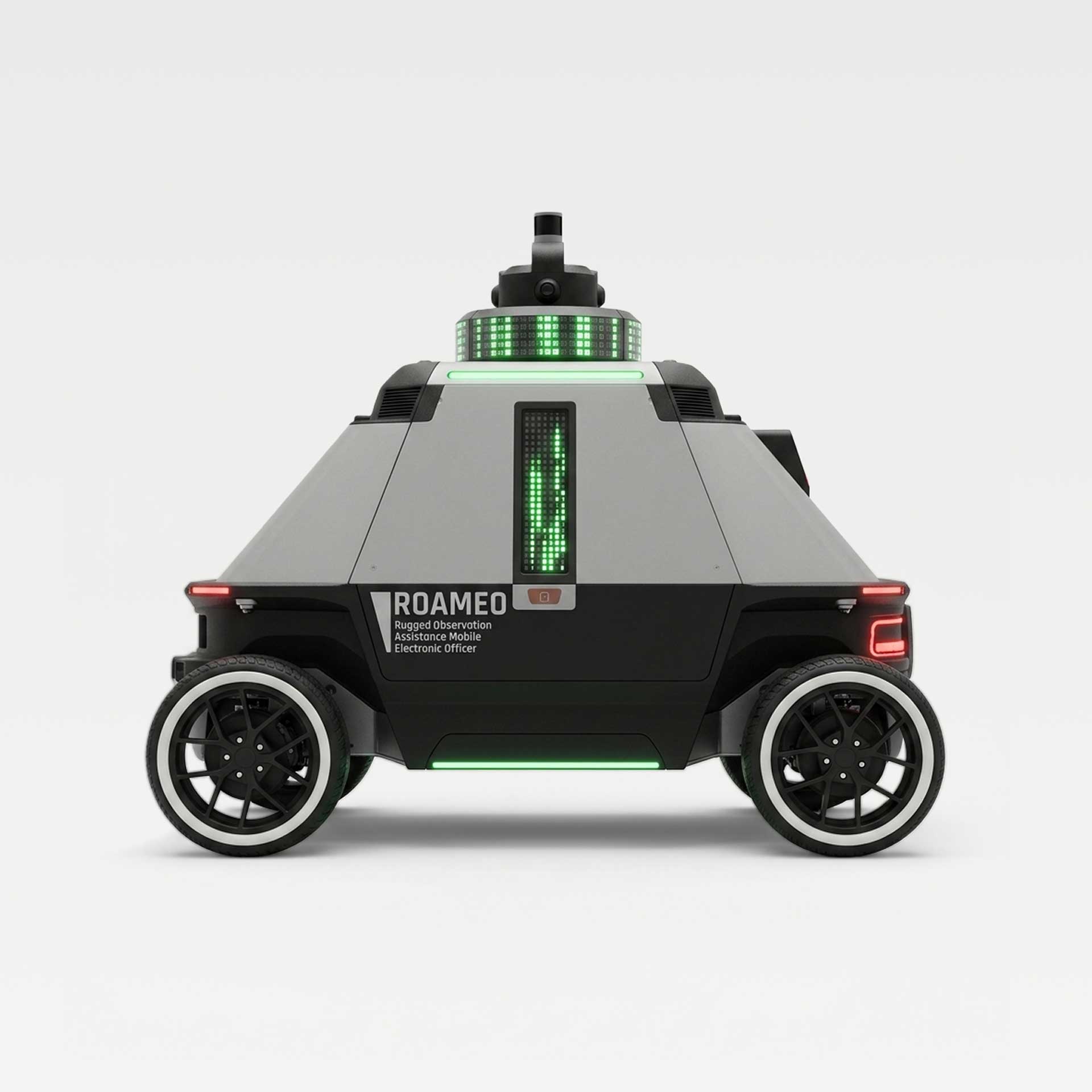
One ROAMEO was operational, a second was scheduled for deployment in October, and a third had been ordered for delivery by year-end. That was the sequence RAD described on October 6 for an unnamed global logistics customer. It is a more useful starting point than treating three orders as three proven deployments. RAD's October 6 order announcement
The order matters because the customer provides security services to other businesses. If autonomous patrol fits that service model, a robot supplier can expand through an organization that already has customer relationships and operational responsibilities. Our finding is that the route to scale may depend as much on a repeatable service package as on the robot's navigation.
A robot has to fit a contract
A patrol demonstration asks whether a machine can follow a route and detect activity. A service provider asks additional questions: which tasks it can promise to perform, how staffing changes, how interruptions are handled and whether the customer will renew. Those questions link technical autonomy to a contract that must survive ordinary operational variation.
RAD says the third unit will support the logistics provider's work for a cosmetics manufacturer. Neither customer is named in the release. The public evidence therefore establishes the supplier's account of an order and intended use, not an independently verified customer endorsement or a disclosed economic result. SecurityInfoWatch reported the same progression on October 6. RAD's October 6 order announcementSecurityInfoWatch's October 6 coverage
The second site is an integration test
ROAMEO's product materials describe mobile patrol, video observation and engagement functions. Those capabilities need to be configured around a site's routes, traffic, operating hours and escalation procedures. A deployment team learns which paths remain usable and which observations require a person to respond. ROAMEO product description
Some of that knowledge can be reused. Standard installation procedures, operator training and maintenance routines can reduce the effort required at the next site. Other knowledge remains local. A truck yard and a cosmetics facility may present different obstructions, pedestrian patterns and sensitive areas. Repeating the sale is not the same as repeating the deployment at lower effort.
This distinction is the central commercial test. If every new location needs a large custom engineering effort, the business behaves partly like a bespoke integration service. If a consistent package handles most sites with bounded adaptation, the supplier and service provider can both expand more efficiently. The robot's autonomy contributes to that package, but does not define the whole of it.
Savings have to survive exceptions
Claims about reduced reliance on staffed patrol are plausible hypotheses to test, not established savings in the disclosed order. The release does not provide a customer-level cost comparison. A meaningful calculation would include installation, communications, remote supervision, site visits, repairs and the work that remains with personnel.
An illustrative example shows the issue. Removing a routine patrol round creates value only if the replacement process does not require frequent unscheduled attendance. A blocked route that is trivial for an on-site guard may become costly when the nearest technician is elsewhere. The relevant measure is the cost of sustained useful coverage, including recovery, rather than hours during which the robot is powered on.
Service providers may be particularly well placed to solve this because they already organize response and customer support. They may also be demanding buyers: a problem with the robot becomes a problem with their own service promise. That can create a strong distribution channel without eliminating pressure on price or reliability.
The counterargument is the small sample
A third order from one unnamed customer is not proof of broad product-market fit. It could reflect an unusually suitable set of sites, a favorable commercial arrangement or confidence that has not yet been tested over time. Delivery and retention evidence will matter more than the number in a headline.
RAD's broader disclosures also describe execution and financing risks, including limited deployed units and the challenge of expanding production. Those company-identified risks belong beside the growth narrative. They do not negate the order, but they make it inappropriate to extrapolate an assured rollout from a small sequence of purchases. RAD's current execution-risk disclosures
There is also a difference between an expansion within one customer and adoption by a different customer. The former can reuse a trusted commercial relationship; the latter tests whether the value proposition survives a new procurement process. Both are useful signals, but they should be reported separately. A repeatable service business ultimately needs evidence that it can carry its methods across customers as well as across sites within a single account.
The evidence that would change the scale story
The next useful disclosures would separate ordered, delivered, accepted and renewed units. They would show whether installation time and support effort fall across successive sites. A named customer discussing the tasks retained by people would be more informative than another general claim that robots replace patrol labor.
If the customer can reproduce the operating model without recreating it at every location, ROAMEO becomes part of a scalable service offering. If each installation remains exceptional, repeat orders may increase revenue without producing equally attractive economics. The decisive autonomy milestone is therefore a repeatable customer outcome, not simply another machine on order.
References
Questions, news tips or corrections? Contact info@securityautonomyreview.com.