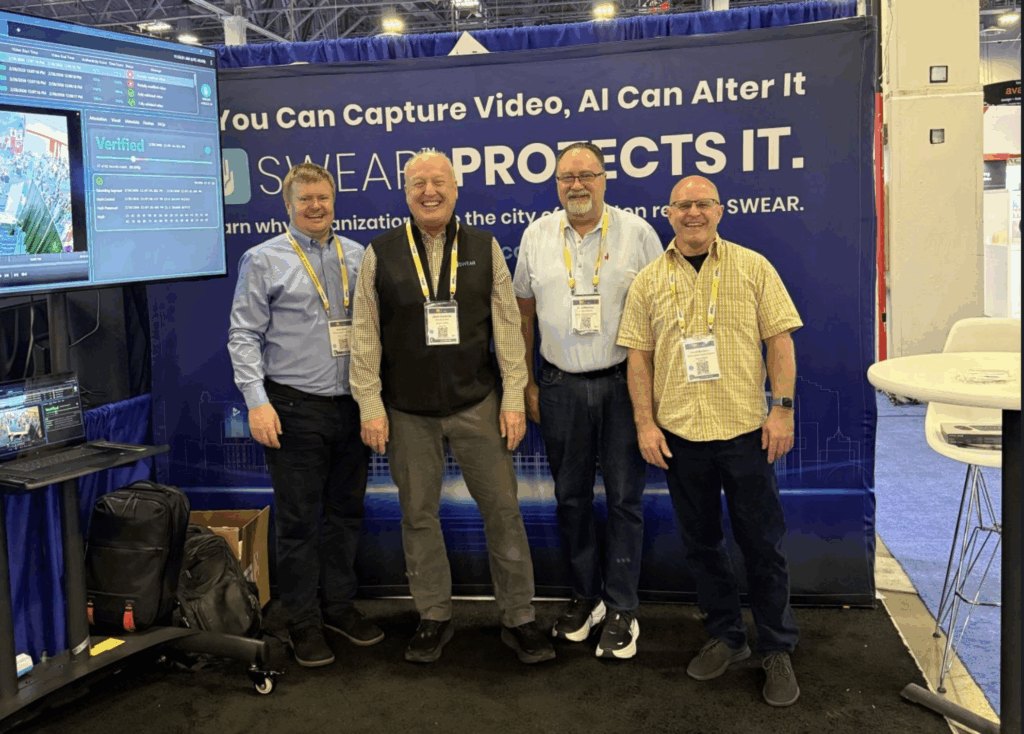
A genuine recording can support a mistaken conclusion. That is the essential distinction behind SWEAR's September 8 Community Video Integrity Project. The company is inviting public agencies to add capture-time authentication to important camera streams, with an initial emphasis on environments using Milestone XProtect. The announcement describes a program and proposed deployments; it does not establish a completed rollout across named cities. SWEAR's September 8 program announcement
The opportunity is significant precisely because its scope is limited. A cryptographic record can help show whether footage has changed relative to an original. It cannot, by itself, decide whether a person in that footage was authorized to enter, whether an object was dangerous or whether an AI summary is fair. Autonomous security needs to preserve both questions instead of allowing one to stand in for the other.
The old problem was custody; the new one includes interpretation
Security teams already need to know where a recording came from and what happened to it after capture. AI-generated and manipulated media add pressure to make that history easier to demonstrate. SWEAR's program targets this evidence problem, rather than offering another detector that estimates whether an image looks artificial.
Its technical description says it creates cryptographic fingerprints during capture and anchors proof data to a permissioned ledger for later validation. The company distinguishes that proof data from storing the video itself. These are vendor descriptions of the design; they do not substitute for an independent assessment of every integration, key-management process or failure condition. SWEAR's technical description
The distinction becomes especially important when an organization asks software to summarize events. The original may remain intact while a generated account introduces an unsupported action, identity or sequence. Protecting the source is valuable, but the generated interpretation must remain traceable to it.
A trustworthy file is not a complete account
Imagine an authentic clip showing a person crossing a restricted doorway. The recording may omit the supervisor who granted an exception, an earlier event outside the selected time window or another camera's view. Those omissions do not make the file fake. They make the interpretation incomplete.
That is why an authenticity result should travel with a clear statement of what was tested. Which stream and time interval were covered? Where in the capture pipeline was the proof created? Was a later export resized, redacted or transcoded? What can a recipient verify without returning to the original operator? These questions define the evidentiary boundary of the system.
SWEAR's community-program page describes later comparison with an original record and an application process for selected organizations. The useful next evidence will be public results explaining those boundaries in an operational environment, including unsuccessful validations and routine export workflows. A list of participating organizations alone would not establish that the complete process works. Community Video Integrity Project scope
The overlooked control point is the transformation
Autonomous security increasingly transforms information: a stream becomes a clip, a clip becomes an alert, and an alert becomes a written account. Each step can change the meaning available to the next person. The strategic value of provenance grows when it allows those transformations to be examined, not merely when it adds a reassuring badge to the final screen.
A practical implementation would keep the original event reference beside the generated summary and record any human correction. It would distinguish the model's interpretation from the camera's observation. That makes it possible to disagree with the software while retaining confidence in the underlying recording.
Milestone's own description of video summarization makes the adjacent workflow concrete: a model produces a textual account from video. It is a different capability from cryptographic integrity, and evaluating it requires different evidence. A summary can save review time while still requiring an operator to inspect the source before making a consequential decision. Milestone's video-summarization explanation
Absence of proof is not proof of fabrication
The strongest caution is against turning a provenance product into a universal truth label. Footage created outside the participating system can be authentic. A failed validation can require investigation into a broken workflow or legitimate transformation. A successful validation cannot establish everything that happened outside the camera's frame.
There is also a straightforward commercial counterargument. Existing custody procedures and platform protections may be sufficient for some organizations. An additional service must justify its complexity, retention obligations and verification dependencies. The case is strongest where recordings are regularly contested or pass through several organizations with different systems.
Watch a disputed clip move between organizations
The revealing test is an ordinary export sent to a recipient who was not involved in capture. Can that recipient verify the relevant history, identify transformations and inspect the original context? Can a model-generated account be corrected without losing its connection to the evidence?
If those questions can be answered, provenance can become a foundation for more accountable autonomous analysis. Its value is not that it makes every conclusion true. It is that it gives people a more reliable source against which to challenge a conclusion.
References
Questions, news tips or corrections? Contact info@securityautonomyreview.com.